Sept. 1st 2026

American Safe Home
Senior Mobility Specialist

If you or a loved one is having difficulty with stairs, you probably have questions. How does a stairlift work? Will it fit your staircase? How much does one cost? Can you still use the stairs after installation?
Choosing a stairlift is an important decision, and understanding your options can make the process much easier.
Below are answers to some of the most frequently asked questions about stairlifts, home accessibility, installation, and aging in place.
What Is a Stairlift?
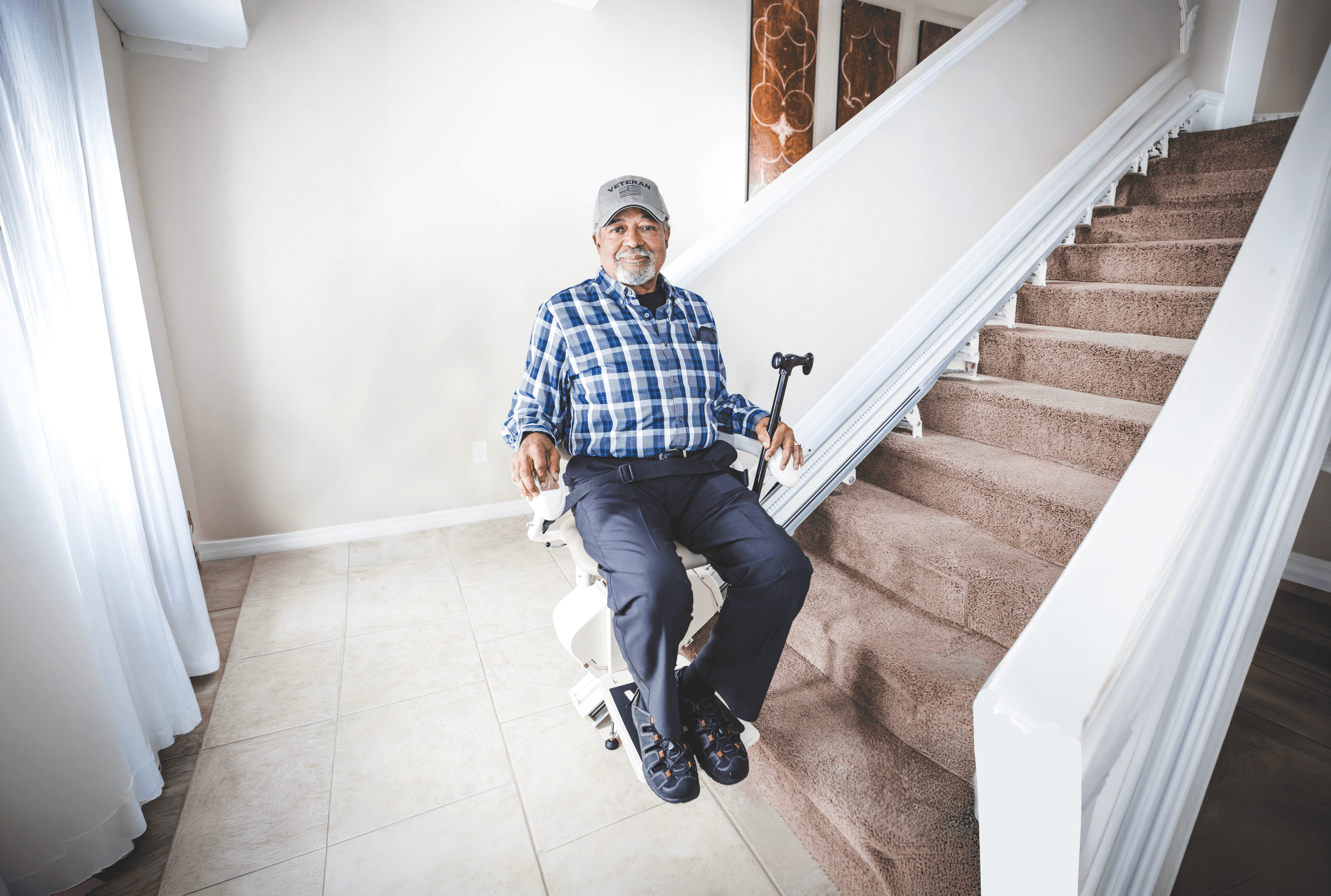
A stairlift is a motorized mobility device that carries a seated passenger along a rail installed on a staircase. It is designed to provide an alternative to walking up and down stairs for people who have difficulty navigating them safely or comfortably.
Stairlifts are commonly used in residential homes and can be an important component of a broader home accessibility plan. Research on home modifications has found evidence that appropriately designed modifications can improve function and participation for people living with a variety of health conditions (Stark et al., 2017).
Are Stairlifts Only for Seniors?
No.
Stairlifts can be used by adults of many ages. While they are frequently associated with aging in place, someone may need a stairlift because of an injury, surgery, disability, chronic mobility limitation, or another change that makes stairs difficult to navigate.
Research on accessible home environments has found that modifications designed around a person's functional limitations can have positive health and social effects (Cho et al., 2016).
A stairlift isn't about age. It's about making your home more accessible to the person who lives there.
When Should I Consider a Stairlift?
There isn't one specific point at which everyone should get a stairlift.
It may be worth exploring your options if:
Stairs have become difficult, painful, or exhausting.
You are avoiding certain floors of your home because of the stairs.
You are recovering from an injury or surgery.
You have difficulty with balance, strength, or endurance.
A disability or mobility limitation makes stairs challenging.
Family members are increasingly concerned about how you navigate the staircase.
You want to make your home more accessible as you plan for the future.
A stairlift can be considered as part of a larger strategy for adapting a home to changing mobility needs.
Can a Stairlift Be Installed on Any Staircase?
Not necessarily—but there are stairlift solutions for many different staircase configurations.
Straight stairlifts are generally designed for staircases that travel in one continuous direction without turns or intermediate landings.
Curved stairlifts can be designed for staircases with bends, turns, landings, or more complex layouts.
The appropriate solution depends on the physical characteristics of the staircase and the user's needs. A professional assessment can help determine which type of stairlift is appropriate for a particular home.
What Is the Difference Between a Straight and Curved Stairlift?
The primary difference is the shape and configuration of the staircase they are designed to accommodate.
A straight stairlift travels along a single straight rail and is typically used for a straightforward staircase.
A curved stairlift uses a rail customized to follow the shape of a more complicated staircase, including curves, bends, and landings.
If you're unsure which type you need, an assessment of your staircase can help determine the appropriate option.
Can I Still Use the Stairs After a Stairlift Is Installed?
In many homes, yes.
A stairlift is designed to provide another way to navigate the staircase rather than necessarily preventing other household members from using the stairs.
The exact amount of remaining walking space depends on the staircase, the lift design, and the installation.
Because every staircase is different, discussing the available space with your installer is an important part of the planning process.
How Much Does a Stairlift Cost?
There isn't one universal stairlift price.
The total cost can depend on factors such as:
Whether the stairlift is straight or curved
The length and configuration of the staircase
Whether it is an indoor or outdoor installation
The model and features selected
Installation requirements
Whether additional accessibility equipment is needed
Straight stairlifts are generally simpler installations than curved stairlifts, while customized staircase configurations can require more specialized equipment and installation.
The best way to determine your actual cost is to request an assessment and quote based on your home.
Are Outdoor Stairlifts Available?
Yes.
Outdoor stairlifts are designed for exterior staircases and can help provide access to raised entrances, porches, decks, and other outdoor areas.
Outdoor installations have different environmental considerations than indoor installations, so the appropriate equipment needs to be selected for the location and conditions.
For homeowners who want to remain in their current home, outdoor accessibility can be an important part of making the entire property easier to use.
What Is a Vertical Platform Lift?
A vertical platform lift, sometimes called a vertical lift or platform lift, moves a person and mobility equipment between different levels.
Unlike a stairlift, which carries a seated passenger along a staircase, a vertical platform lift travels vertically between levels.
This type of solution may be useful when someone needs to accommodate a wheelchair, mobility scooter, or other mobility equipment, depending on the specific product and installation.
Will a Stairlift Work During a Power Outage?
Many modern stairlifts use rechargeable batteries, allowing them to continue operating for a period of time when household power is unavailable.
However, battery capacity and outage performance vary by model and circumstances. Ask your stairlift provider about the specific battery system, charging requirements, and expected operation during a power interruption.
How Long Does Stairlift Installation Take?
Installation time depends on the stairlift and the staircase.
A straightforward straight-staircase installation may be relatively quick, while a curved stairlift or more complicated installation can require additional preparation.
Your installer should provide a more specific estimate after evaluating the staircase and determining which equipment is required.
Does Installing a Stairlift Damage My Home?
A stairlift is typically installed directly to the staircase rather than requiring major structural remodeling.
However, installation requirements vary depending on the staircase and the specific product.
Before installation, your provider should explain how the equipment will be mounted and whether any modifications to the home are necessary.
Can a Stairlift Help Me Age in Place?
A stairlift can be one part of an aging-in-place strategy.
Aging in place means continuing to live in a familiar home and community as your needs change. Home modifications can help make that possible by adapting the environment to the person.
A 2025 systematic review of home modifications found evidence supporting benefits related to functional independence and fall prevention, while also emphasizing that modifications should be personalized to individual needs (Cha, 2025).
Other research has similarly found that accessible home environments and appropriate modifications can support independence and participation for people with functional limitations (Cho et al., 2016; Stark et al., 2017).
A stairlift isn't necessarily the right answer for every home or every person. But for someone struggling with stairs, it may be one practical way to make a multi-level home more accessible.
References
Cha, S.-M. (2025). A systematic review of home modifications for aging in place in older adults. Healthcare, 13(7), 752. https://doi.org/10.3390/healthcare13070752
Cho, H. Y., MacLachlan, M., Clarke, M., & Mannan, H. (2016). Accessible home environments for people with functional limitations: A systematic review. International Journal of Environmental Research and Public Health, 13(8), 826. https://doi.org/10.3390/ijerph13080826
Sheth, S., & Cogle, C. R. (2023). Home modifications for older adults: A systematic review. Journal of Applied Gerontology, 42(5), 1151–1164. https://doi.org/10.1177/07334648231151669
Stark, S., Keglovits, M., Arbesman, M., & Lieberman, D. (2017). Effect of home modification interventions on the participation of community-dwelling adults with health conditions: A systematic review. American Journal of Occupational Therapy, 71(2), 7102290010p1–7102290010p11. https://doi.org/10.5014/ajot.2017.018887